Science makes Sense, Week 17: Phosphorus, fertilizers, ATP , LEDs , phossy jaw and wars.

December 12, 2015

When we were growing up in India, power failures were common and we all had candles and matchboxes handy.  The sides of those little boxes had a brownish- red tint and we struck our little match – heads on the sides to light them and light up candles.  Later, we saved the match- boxes to play games.  We made miniature furniture, or used them to save our trinkets and little stickers.

The match- heads had phosphorus.  The chemical symbol is P and it is the 15th element in the Periodic Table.  It is part of the Nitrogen Group, in between Silicon and Sulfur.  Next to Calcium, Ca, Phosphorus is the most abundant element in the body. (Ref.1)  It is essential in the building blocks of our bones and genes,viz.,the DNA and RNA.  Actually most of us have more P than we need since it is found in a lot of foods that we eat.

Phosphorus was discovered in 1669 while working with urine!  Hennig Brand, a German alchemist, heated the residue left behind after the evaporation of urine.  Elemental phosphorus was discovered.  In nature, one never finds elemental P but it is always found as rock phosphates. (Ref. 2)   A hundred years later, it was extracted using bone , which has become the traditional way of chemically producing phosphorus. (Ref. 3)

Phosphorus, P, exists in 3 allotropic forms, red, white and black.  Red and white are more common. (Nuggets of Information) Both red and white P are poly-atomic and are 4 P atoms that form a tetrahedron. (Fig.3)  White phosphorus reacts vigorously with oxygen and the reaction results in a popping sound that is similar to a dog barking. Phosphorus pentoxide is formed during the oxidation process (Ref.4):

P+  5O2        →    2P2O5

The chemical behavior of phosphorus is interesting because as a non-metal it exhibits ionic and covalent  bonding depending on where it is present.  It is an important element  in complex organic compounds like ATP, (adenosine tri-phophate) as well as in simpler molecules like phosphoric acid ,H3PO4, oxides of phosphorus, or as a phosphate, PO43-  in an inorganic compound.  ATP is an energy-bearing molecule present in all living organisms. (Ref.5)(Fig.3)(Nuggets of Information)

The most common use of phosphorus is in the manufacture of fertilizers. It is also used in the production of steel and was used extensively in the manufacture of detergents, though lately phosphate-free detergents are more prevalent.  This is because the phosphates that leached into water bodies affected it adversely.

There is much talk about peak phosphorus today.  This means that our demand is exceeding the supply of phosphorus.  In 2008, the world was shocked by an 800% increase in the price of phosphorus. Several factors including world reserves, agricultural practices using excessive amounts of manufactured phosphates have played a role in this shortage.   As a society, we need to be cognizant of these problems and figure out ways to counteract the decrease in phosphorus. (Nuggets of Information)(Ref. 6)

Activities for Middle School Teachers:

Phosphorus has several allotropes. What other elements exhibit allotropism?

Study several biological processes that need  ATP. (Nuggets of Information)

Study the reaction of phosphorus with the halogens( F, CL, I, Br, At) and balance the equations.

Nuggets of Information:

Phosphorus is named from the Greek phrase:’bringer of light’. (Ref.7)

Phosphorus exists as mainly three allotropes: red, white and black. The red and white form have a tetrahedral structure with 4 phosphorus atoms at each corner of the tetrahedron. (Fig.3)  The black allotrope  has a layer-like structure where one layer of P atoms are layered over another.  The red allotrope has a hard crystalline structure and is non -poisonous and more stable than the white or yellow allotrope.  The white P is soft and waxy, poisonous and spontaneously combusts in the presence of oxygen. Black P is the least reactive form and has a metallic lustre. (Ref.8)

Phosphoric acid is added to cola drinks to give it their sharp taste. (Fig. 7) Magnesium phosphide,  Mg3P2, is used as warning flares  and phosphorus, P, is used in Light Emitting Diodes or LEDs. (Fig. 7)

Knowing the combustible nature of white P, one of the most awful uses of White P has been in warfare.  From World War 2, it has been used in tracer bullets, firebombs and in Middle East wars, where victims are burnt in horrific ways.  Lately P has been used to make nerve gases like Sarin and was released in a Tokyo subway in 1995. White P was also used to make matches in the 19th century, but no-one realized how deadly the vapours were till the young girls working in the factories developed phossy jaw, which ate the jaw bone.  (Fig. 7)

As mentioned earlier, too much P in water can make it a pollutant, choking the biological life in streams and lakes.  What happens is that there is too much plankton growing that kills fish and other water life. There is also prevention of sunlight from reaching lower levels of the water, thereby killing several species there as well.  This process is called eutrophication. (Ref. 9)

Just like there is a nitrogen cycle in nature, we have a phosphorus cycle as well.  It differs from other cycles because the gaseous phase is minimal. Most of the phosphates are found in sedimentary rocks.  When it rains, the process of erosion and weathering distributes the P in the soil and water.  Plants absorb the phosphates and animals eat the plants.  The phosphates are returned to the earth and rocks through the urine and feces from animals, as well as during decomposition and death of animal and plant matter.  Aquatic eco systems also imbibe the phosphates through sewage seepage, fertilizer runoff and from industrial wastes.  Animals eat the plants and the process is continued as before.

Phosphorus is found in a lot of foods we eat.  Many lentils, meats and fish like salmon contain P.  In addition, a lot of nuts like Brazils, cashews and almonds contain P.(Ref.10)

Adenosine-Tri-Phosphate, or ATP is the energy currency in several cell mechanisms.  During respiration and exercising, which means almost all the time, ATP is necessary for all living beings.  The structure of ATP has an ordered carbon compound as the main part; however the phosphorus is critical.  Three of the phosphorus atoms are linked via oxygen atoms and there are extra oxygen atoms attached to each of them as well.  The negative charges on the oxygen when the hydrogen leaves as a proton on the hydroxyl groups, OH, makes them have high potential energy.  This means they are not stable and are willing to lose a phosphate ion from an end to form ADP, Adenosine-Di-Phosphate.  The conversion of ATP to ADP releases about 7.3 Kcal per mole.  Living things use ATP like a battery, since it powers reactions by losing a phosphate and becomes ADP.  Food energy converts the ADP once again to ATP and the process is repeated. (Fig.3)(Ref. 11)


IMG_2615IMG_2616

IMG_2618

References:

  1. https://www.nlm.nih.gov/medlineplus/ency/article/002424.htm
  2. http://www.scienceshorts.com/articles/Discovery%20of%20Phosphorushtm
  3. http://www.chemicool.com/elements/phosphorus.html
  4. http://dwb5.unl.edu/CHEM/Redox/RedoxA13.html
  5. http://science.howstuffworks.com/dictionary/plant-terms/adenosine-triphosphate-atp-info.htm
  6. http://www.sciencedaily.com/releases/2014/02/140203083830.htm
  7. http://www.rsc.org/periodic-table/element/15/phosphorus
  8. http://chem-guide.blogspot.com/2010/04/allotropes-of-phosphorous.html
  9. http://enviroliteracy.org/air-climate-weather/biogeochemical-cycles/phosphorus-cycle/
  10. http://lifestyle.iloveindia.com/lounge/phosphorus-rich-foods-3844.html
  11. http://hyperphysics.phy-astr.gsu.edu/hbase/biology/atp.html
Science Makes sense, Week 16: Chemistry and Social Justice, hair and nail salons,glues,EMA and Brazilian Blowout

December 6, 2015

The rituals with hair are seen all over the world.  In India, hair and its maintenance is probably still a time-consuming job for mothers with young girls and boys.  I am still struck by little children going to school in India with shiny black hair neatly combed for boys and  braided evenly for the girls as they trot to school.  It does not matter how poor the family is, the children are very well-groomed.

My mother would spend everyday combing, oiling and braiding my long hair before we rushed off to school.  Then, during the weekend, ‘oil bath’ and local powders called ‘Sheekapodi’ were used to clean the hair.  The concept of shampoo was non-existent let alone entering hair salons. Today nail and hair salons proliferate not only in western countries, but in India as well.

We will look at the chemicals used in hair and nail salons and talk about the effects they have especially on the workers.

IMG_2609IMG_2608

IMG_2612


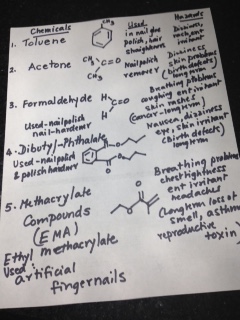
Toluene is used in nail gluing, nail polish and in hair straighteners. This organic compound is benzene with a methyl group attached. (Benzene is basically a cyclic compound with 6 carbons and 6 hydrogen atoms.)  Short -term exposure may cause dizziness, rashes and ear-nose -throat (ENT) irritation.  Acetone is a nail polish remover and is also available in any supermarket.  This also causes dizziness, skin problems and long-term exposure leads to birth defects, if the workers are pregnant. Formaldehyde is used for nail polish as well as a nail-hardener: causes breathing problems, coughing , skin rashes and is an ENT irritant.  Long-term exposure could lead to cancer.   Another organic compound shown as #4 in the second figure, di-butyl phthalate, is used like formaldehyde and causes nausea, dizziness along with birth defects with long-term exposure.  And then there is EMA, which is ethyl methacrylate (#5, Fig.2), used in artificial fingernails, that causes similar problems in workers. (Ref. 1,2)

Needless to say, I have looked at only a few chemicals in the nail salon industry.   In addition, when it comes to hair salons, there are many products to worry about.  A ‘perm’ or permanent was done at home by women who grew up in the ’50s.  Women used keratin , a protein that actually weakens hair. (Ref. 3 and in Nuggets of Information)  Weaving of hair is done not just in the African-American community, but now every celebrity/person with money who wants fuller, thicker hair can get it done.  There are men , besides women, who are going in for hair extensions.  The process involves stitching, gluing human hair to the scalp and can cause severe skin rashes, allergies and even loss of hair.  These glues also affect the workers who inhale it all the time. (Refs.1,4,5)  The glue contains styrene,  an ethene attached to a benzene molecule.  It causes dizziness, headaches and long- term exposure may lead to cancer. (Ref.1 )(Fig.3) Then there is the above-mentioned formaldehyde that is used in creating Brazilian Blowout, a hair treatment that will straighten curls and frizz or create it.  We already know that it is toxic for the workers. Ref.6)

The list of toxic chemicals goes on and on.  There is more information under Nuggets of Information.  I have included some alternatives to the regular list of hair and nail salons.  But we must look not just for our own health concerns but those of the workers who are constantly exposed to this barrage of toxicity.  The good news is that awareness is growing, there is more advocacy for the workers, but all that is being done is just a drop in the bucket.  More needs to be done to change this love affair we have with the dead cells in our bodies.

Activities for Middle School Teachers:

Talk about hair and nail grooming practices in different parts of the world. Students will learn geography and culture all over the world.

Study the history of African-American hair and special hair salons for them.

Go to the supermarket and check out the hair and nail products division and study the chemical ingredients in all of them.  Let students do a presentation on the chemical structure, usage of product and its toxic side-effects.

Study hair styles through the ages especially in the United States focusing on Caucasian and African American groups.

Nuggets of Information:

Human hair export, from India, is a multi-million dollar industry. Indians, especially Hindus, believe in shaving off all their hair as a gift to the gods. Men and women with long black hair, frequently go to temples to be shorn of their tresses.  The demand for wigs and hair extensions is high in the US, UK and parts of Europe. (Ref. 7)

Nails and hair are considered extensions of the skin.  Hair and nails cells grow at the base of the root, and when they move upward, they are cut off from nourishment to form a hard protein called keratin. This keratin and the dead cells form the shaft of hair or nail. (Ref.8)

Four out of ten workers in the nail and salon industry are poor Asians with limited English-speaking skills, uninsured and working in badly-ventilated spaces. Fortunately, ACLU and other labor organizations are advocating for their awareness of a safe environment to work in. The California Health Nail Salon Collaborative, along with environmental and community organizations are trying to ban the ‘toxic trio’ of formaldehyde, dibutyl-phthalate and toluene in hair/nail salons. (Ref.7)

Celebrities like Jennifer Anniston have come out openly to talk about the hazards and adverse effects of hair extensions.  Some famous singers have had bald patches in their hair because of these extensions.  Perhaps the public will not be swayed and charmed by the commercials that laud their beauty. (Ref.9)

Recently, there is an increase in American NFL football players with long dreadlocks.  Some of them could be wearing hair extensions, since they are getting popular among men now. (Ref. 10)

How does a ‘perm’ work? The protein molecules in the hair called keratin are arranged in straight molecules joined by disulfide bonds (-S-S-) which gives strength to the hair. (Actually the amino acid cystein in the keratin molecule forms the -S-S- bond with another cystein in a second keratin molecule.)  Ammonium thioglycolate, ( HSCH2CO2NH4) or ‘thiol’ can break the bonds and allow manipulation of hair: either put in curlers to curl straight hair or use a flat iron to straighten curly hair. This is a reduction process (which is opposite of oxidation) and oxygen is lost or hydrogen is added.  Following this Hydrogen peroxide, H2O2 , is added to strengthen the hair, an oxidation process.

Sometimes, lye soap is used instead of ‘thiol’.  Lye is a 10% solution of NaOH or sodium hydroxide which does the same reduction; then it is thoroughly washed out with conditioner and water to prevent corrosion of the scalp. (Ref.11)  As you can see, continuous perming of hair can lead to seriously damaged hair.

Some encouraging news to help us modify our nail and hair salon addictions:

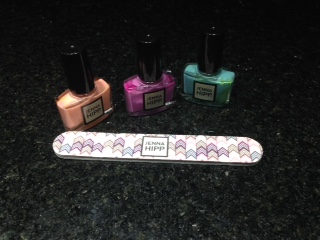
  1. Jenna Hipp has come up with nail polishes that avoid the toxic- trio chemicals, check out her other products. (Ref.12)
  2. Campaign for Safe Cosmetics is an advocacy group that helps workers and consumers make smart choices and are aware of the hazards and side effects of products that keep coming out in the cosmetics industry. (Ref.13)
  3. No more dirty looks is a blog site with good alternatives for hair products. Check out their book as well. (Ref. 14)

References:

1.http://www.womensvoices.org/avoid-toxic-chemicals/salon-products/toxic-chemicals-in-salon-products-workers/

2.http://www.scientificamerican.com/article/these-4-chemicals-may-pose-the-most-risk-for-nail-salon-workers/

3.http://www.ask.com/beauty-fashion/chemicals-used-perming-hair-79b66ed09938762a

4.http://www.consumerreports.org/cro/2013/02/the-dangers-of-hair-extensions/index.htm

5.http://www.nydailynews.com/life-style/hair-extensions-latest-well-tressed-man-article-1.1497062

6.http://www.alternet.org/story/155982/toxic_chemicals_in_hair_and_na    il_salons_create_serious_suffering_in_the_name_of_beauty/

7.http://www.scienceandnature.org/IJEMS-Vol2(4)-Oct2011/IJEMS_V2(4)4.pdf

8.http://kidshealth.org/teen/your_body/body_basics/skin_hair_nails.ht       ml

9.http://www.dailymail.co.uk/femail/article-2274414/Dangers-hair-extensions-Blinding-headaches-bleeding-scalps-permanent-baldness.html

10.http://www.nydailynews.com/life-style/hair-extensions-latest-well-tressed-man-article-1.1497062

11.http://www.humantouchofchemistry.com/the-chemistry-of-perming-rebonding.htm

12.http://www.therecessionista.com/2014/07/jenna-hipp-introduces-eco-friendly-nail-polish.html

13.http://www.safecosmetics.org/

14.O’Conner, Siobhan &  Spunt, Alexandra, No More Dirty Looks  (De Capo Lifelong Books, 2010)


Science Makes Sense Week 15: Organic Chemistry, organic acids, alcohol, illicit liquor and alpha-hydroxy acids.

November 30, 2015

IMG_2595

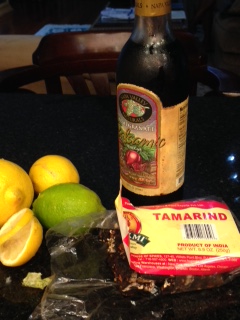
My supervisor in Chicago used to add a slice of lemon every time he drank water.   I tried doing that for a while but that habit was short-lived.  Now I hear again about the benefits of drinking warm water in the morning with lemon-juice. (Ref.1)  Apparently it aids digestion and helps in many other ways.  Cooks also tend to use lemon zest to add zing and flavor to many salads and dishes.

Lemon juice contains citric acid, which is really an organic acid.  All citrus fruits (like oranges, grapefruit, lemons, lime) contain this  acid.

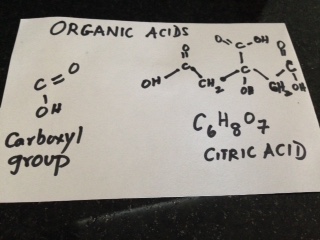
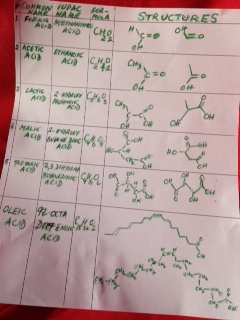
An organic acid has the general formula R-COOH, where R could be a number of carbon and hydrogen atoms arranged as straight, branched or in a cyclic arrangement.  The COOH arrangement and the formula of citric acid are shown in the second picture.

As you can see, the formula is quite complicated.  However all organic acids have one or more of the -COOH or carboxyl group and are sometimes called carboxylic acids.

Let us start with simple organic acids.  When R=H, the formula of the organic acid is HCOOH and is called formic acid.   This is the acid found in ants!  The next acid in the series has R=  CHwhich is a methyl group and the formula is CH3COOH  and is called acetic acid.   This is the acid in vinegar and vinegar products like balsamic vinegar.  The more accurate IUPAC nomenclature (naming) of organic acids would use the name methanoic acid for formic acid and ethanoic acid for acetic acid.  The next acid in the series will have three carbon atoms and the carboxyl group and will be propanoic acid and so on.

But we need to look at common organic acids besides formic and acetic acid.  Mexicans and Indians are familiar with tamarind, used in cooking especially in Indian dishes.  This adds a tart taste to dishes and contains an acid called tartaric acid.  Milk contains the acid, lactic acid.  Most organic acids are weak acids, which means the acid is not completely ionized and the percentage of the hydronium ions present is low.  Just note that all organic acids have the characteristic COOH or carboxyl group present.

Remember methane as the first in the hydrocarbon series alkanes? Replace one of the hydrogens with the hydroxyl group OH and you get your first alcohol, methyl alcohol.  Unlike inorganic compounds where the presence of the hydroxyl group, OH, implies a base, the OH  here indicates alcohols.  The next in the series is ethyl alcohol, the familiar alcohol everyone imbibes.  None of the other alcohols in the series can be ingested.   An isomer of the next alcohol (propyl alcohol) is isopropyl alcohol and is familiarly known as rubbing alcohol used for medicinal purposes.  Methyl alcohol is also called wood alcohol and is used in many applications, but lately is found to be the best fuel for automobiles.(Ref.2)

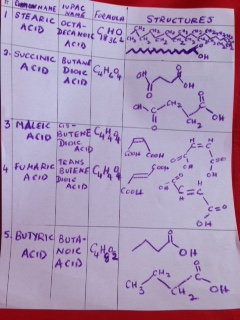
Higher organic acids/carboxylic acids, like stearic acid are used in the manufacture of soaps.(Fig.3) Acetic acid is used in food and other acids are used as preservatives.  Acetic acid is also used in the manufacture of rayon.(Ref.3)(Fig4)

Activities for Middle School Teachers:

Let students go up to 12 carbons with a COOH group to write straight chain and branched chain organic acids.  Use the IUPAC name, (explained in Nuggets of Information).

Do the same with alcohols.

Note the number of isomers in each case. What kind of isomers do you obtain? ( Position of COOH/OH as well as cis-trans isomers and mirror image isomers)

As the number of carbon atoms increase are the acids liquids or solids?

Using ball and stick models or toothpicks, raisins and cherry tomatoes and marshmallows, construct the different isomers, say for a 5-carbon acid.

Nuggets of information:

The origin of the word ‘alcohol’ comes from Arabic which literally means al kuhl and refers to kohl/ antimony powder used with ethyl alcohol on the eyes.  Years later it was used to refer just to ethyl alcohol and in chemistry generally to all alcohols. (Ref.4)

Methyl alcohol has many names besides wood alcohol: wood spirit, hydroxy methane, Colonial spirit, Columbian spirit and also methanol. It has been used for embalming bodies by the ancient Egyptians.  The word ‘methyl’ was derived from Greek where ‘methy’ means wine and ‘hyle’ means wood or path of trees.  So people have been making illicit liquor using methyl alcohol for centuries. (Ref. 5,6)  Unfortunately, in many countries like India, people have died imbibing illicit liquor, because small amounts of methyl alcohol may not harm individuals but larger amounts leads to blindness, dizziness and even death.  Small amounts are already present in the fruits we eat. (Ref.7,8)

Part of the work of the International Union of Pure and Applied Chemistry or IUPAC is to set the rules for  the nomenclature of chemical compounds. So along with common names for organic acids and alcohols we have the standard IUPAC names as well. (Ref.9)

AHAs and BHAs are now very popular facial exfoliants.  AHA s are α-hydroxy acids like malic acid (from apples), tartaric acid ( from tamarind, grapes) and citric acid from citrus fruits) (Ref.10,11) (Figs. 2,4)  These AHAs are very popular for treating dermatological problems and have even been used for Fibromyalgia.  The only BHA or β-hydroxy acid used is salicylic acid. (Ref.12) which is a cyclic compound also called 2-hydroxy benzoic acid.  Salicylic acid is the active component in aspirin as well.

Oleic acid has been found in olive oil and has been considered to be  a good dietary supplement for people with diabetes. (Ref.13)(Fig.4)

Succinic Acid is a colorless crystalline solid, used in perfume making, medicine, manufacture of lacquers and in food production.It has two carboxylic -COOH groups and has 4 carbon atoms and is also called butanedioic acid (Ref.14)(Fig.3)

Maleic and Fumaric acids are cis and trans isomers,, have 4 carbons,also two carboxyl groups,-COOH,  but with a double bond each and can be manufactured starting with a derivative of succinic acid.  They are currently being used as food additives. (Ref.15,16) (Fig.3)

Butyric acid is produced when butter turns rancid.  It also has 4 carbons and is Butanoic acid, but with only one carboxyl group, -COOH. (Ref..17)(Fig.3)

Intense exercising can lead to lactic acidosis, which really means a high build up of lactic acid in the muscles.  This could lead to nausea and stomach pain, a temporary condition. (Ref.18)(Fig4).

Many times when people eat rich food, they talk about’acid reflux’.  This is probably the stomach walls producing more acid to digest all that food. Antacids, which are bases help neutralize the acid but maybe lemon juice everyday might be a better solution.  I end with more evidence that lemons are anti-bacterial, anti-viral and aid in digestion. (Ref.19)  Worth giving that a try, why not?

IMG_2596IMG_2600IMG_2601

References:

1.http://tasty-yummies.com/2013/03/18/10-benefits-to-drinking-warm-lemon-water-every-morning/

2.http://www.methanol.org/Methanol-Basics/Methanol-Applications.aspx

3.http://www.preservearticles.com/201101022309/uses-of-carboxylic-acids.html

4.http://www.silkworth.net/timelines/timelines_public/origin_alcohol.html

5.http://www.biologycorner.com/worksheets/articles/wood_alcohol.html

6.Blum, Deborah, Poisoner’s Handbook,(Penguin Press,2010)

7.http://www.toledoblade.com/World/2011/12/15/Bootleg-liquor-containing-toxic-methanol-kills-143-people-in-east-India.html

8.http://www.methanol.org/Health-And-Safety/Safe-Handling/Methanol-Health-Effects.aspxhttp://old.iupac.org/index.html

9.http://old.iupac.org/index.html

10.http://www.drugs.com/npp/fruit-acids.html

11.http://www.prweb.com/releases/2013/4/prweb10669564.htm

12.http://dermatology.about.com/cs/skincareproducts/a/bha.htm

13.http://www.rsc.org/chemistryworld/2014/04/olive-oil-oleic-acid-diabetes

14.http://pubchem.ncbi.nlm.nih.gov/compound/succinic_acid

15.http://www.scribd.com/doc/61907186/Maleic-and-Fumaric-Acid#scribd

16.http://www.businesswire.com/news/home/20141021005530/en/NIPPON-SHOKUBAI-Announces-Acquisition-Halal-Certification-Organic

17.http://www.infoplease.com/encyclopedia/science/butyric-acid.html

18.http://www.webmd.com/fitness-exercise/guide/exercise-and-lactic-acidosis

19.http://www.beliefnet.com/Wellness/Health/Physical-Health/Hidden-Health-Secrets-of-Lemons.aspx


Science Makes Sense Week 14, Acids,Bases Theories, Neutralization reactions, Salts

November 23, 2015

Whenever the word ‘salt’ is used by people they usually refer to common salt or table salt with the general formula NaCl and written chemically as sodium chloride.  This is the edible salt I have spent a whole week talking about, including  chemical structure and its importance in history. (Week 9)  In Chemistry, the word salt is used more generally  and includes the product formed whenever an acid and a base ( that we studied last week) react with each other.  The reaction is called a neutralization reaction, since the original properties of the acid or the base are neutralized and a new substance, a salt, and water are formed:

HCl  +  NaOH  →  NaCl  + H2O

HCl  +  KOH     →  KCl   +  H2O

2HCl  +  Ca(OH)2   →  CaCl2  + 2H2O

HNO3   +  NaOH     →    NaNO3   +H2O

HNO3   +  KOH         →     KNO3   +  H2O

2HNO3  +  Ca(OH)2  →     Ca(NO3)2    +  2H2O

 H2SO+  2NaOH      →    Na2SO4    +  2H2O

H2SO+  2KOH         →    K2SO4    +2H2O

H2SO4   +  Ca(OH)2        →   CaSO4    +2H2O

As you can see there are several salts that can be formed when an acid and a base react. The salts are sodium chloride, potassium chloride, calcium chloride, sodium nitrate, potassium nitrate, calcium nitrate, sodium sulfate, potassium sulfate, calcium sulfate, respectively.  So with three bases and three acids we have a total of 9 salts!  The other product is always water.   So now we know that another property of an acid is that it can react with a base to form salt and water.  Of course another property of a base is that it can react with an acid to form salt and water.

Last week, we talked about H or hydrogen ion as characteristic of all acids; in actuality a hydrogen ion is just a bare proton and does not exist by itself in an aqueous (in water) solution.  It  exists as a hydronium ion shown below:

IMG_2540

So, when hydrogen chloride HCl gas reacts with water to form hydrochloric acid, which is a liquid, it forms the aqueous hydronium ion and the chloride ion:

HCl (g)  +   H2(l)  →  H3O+(aq)   +  Cl(aq)

According to the Br∅nsted Lowry  Theory, the proton donor is the acid, HCl and the proton acceptor is the base,  H3O+, the hydronium ion.  It is important to rewrite all the above equations in the ionic form as well as remember that since the reaction can only take place in the the presence of water molecules so the hydrogen ion is  not just a proton, but a hyrodinium ion.(Ref. 1) 

Old fire extinguishers were made using baking soda and acid to generate carbon dioxide.  Baking soda is sodium bi-carbonate, NaHCO3, a salt, and the reaction takes place when the bottle containing acid is broken during use. (Ref.2)  Today we use pressurized carbon dioxide with a propellant. Sometimes water sprinklers are set up in homes without anything else for extinguishing fires.  So salts are not used these days in fire extinguishers.  (Ref. 3)

But salts play an important part in industry, medicine and everyday life. Lives are saved by UNICEF when they give people a sodium chloride and sugar solution to drink when dehydrated and suffering from heat exhaustion, thereby supplying oral re-hydration therapy. (Ref. 4)  We already know that sodium carbonate is used in the glass-making industry. Epsom salts or magnesium sulfate is used for minor home remedies and treatments.(Fig.5)  Calcium sulfate is used in food preparation, especially in making soy milk coagulate (turn solid or semi-solid) to tofu, as a calcium supplement and for minor joint aches and pains, as well as a fertilizer.(Fig.6) Needless to say, there are several more salts not mentioned, but you now have a taste of the applications of different salts in different fields.

Activities for Middle School Teachers:

We have not even considered acids like phosphoric acid, iodic acid and bromic acid.  Add to that, common bases with barium, Ba,  and lithium, Li and the list of salts increases.  To calculate the number of salts that can exist, list all the possible acids  and bases and use the multiplication principle from mathematics to calculate the total possible salts.

Starting with a single acid like hydrochloric acid,  HCl (aq), if you replace the hydogen ion, (or hydronium ion in aqueous solutions) by metal ions, check how many salts you can create! (Ref.1)

Last week we talked about moles and molarity.  Molarity is really the concentration of the acid/ base or any chemical compound, usually in water or what is known as an aqueous solution.   Knowing the moles present from an equation, you should be able to calculate the products in grams if the reactants are also given in grams.  It will be a simple proportionality problem.  Try it.

Some uses of a few salts is given above; do a study on the uses of salts in industry, medicine, manufacturing of goods.

Nuggets of Information:

Several theories have been put forward to explain acids and bases. Besides explaining their  physical properties, in 1884, Svante Arrhenius defined acids and bases as:

An Arrhenius acid solution contains an excess of H+ ions.

An Arrhenius Base solution contains an excess of  OH– ions.

Then in 1923,  Br∅nsted Lowry (a Danish and an English chemist) put forward their definitions indicated above.   Finally Lewis made it even more general by saying that  an acid accepts electrons and a base donates electrons. (Ref.1)

Hydroxides of some metals like zinc, Zn, aluminium, Al, and Chromium,Cr are  amphoteric.  This means they can act as both acids and bases.  When treated with a strong acid, they act like bases and when treated with a strong base, they will react as an acid (Ref.1):

Zn(OH)2 (s)  +  2HCl (aq)  →     ZnCl2 (aq)  +  2H2O (l)

Zn(OH)2 (s)   +  2NaOH (aq) →   Na2Zn(OH)4 (aq)

What is the ‘cool fizz’ we feel when we drink soft drinks?  Chemists say that the tingling  on our tongues is caused by chemisthesis.   This sensation does not involve taste or odor receptors, but is due to a chemically induced sensation.  Protons, Hare released when an enzyme called carbonic anydrase reacts with carbon dioxide.  The nerve-endings are acidified by the protons and hence there is tingling.(Ref.1)

As seen above, there are probably more salts than acids and bases.   Most of the rocks and minerals found in nature are some form of a salt. Metal mining involves finding metals like iron, Fe, gold, Au, and other metals as salts.  Salts are usually crystalline and have high melting and boiling points. (Ref.1)

All these compounds are ionic compounds and exist as charged particles. Just like acids and bases, salts are electrolytes. Electrolytes are substances that conduct electricity in an aqueous solution. (Ref.1)  

Some of the formations in caves called stalactites and stalagmites are nothing but salts of calcium carbonate.  Salts like carbonates and bicarbonates react with acids to release carbon dioxide, along with an ionic salt and water:

2HCl (aq)  +  Na2CO3 (aq)  →    2NaCl (aq)  + H2O (l)  + CO2 (g)

HCl (aq)  +  NaHCO3 (aq)  →     NaCl (aq)  + H2O (l)  + CO2 (g)

Last week we only considered strong acids and bases.  These are also strong electrolytes , which means that they are almost 100%  ionized in an aqueous solution.  But there are also weak inorganic acids and bases that do not dissociate completely to H+, or more exactly, H3O+,or OH. Examples of weak acids are nitrous acid, carbonic acid and weak bases include ammonia., also called weak electrolytes. These acids and base do not get ionized completely.  If you connect an electric bulb to a strong electrolyte like sodium choride, hydrochloric acid or sodium hydroxide, the bulb will glow brightly.  With weak electrolytes, the bulb will glow dimly.(Ref.1)

References:

  1. Hein, Morris & Arena, Susan, Foundations of College Chemistry,pp.375 -79(John Wiley and sons, 2007)
  2. http://www.answers.com/Q/How_do_soda-acid_fire_extinguishers_work
  3. http://www.scientificamerican.com/article/what-chemicals-are-used-i/
  4. http://www.csd-i.org/oral-rehydration-techniques/
  5. http://www.care2.com/greenliving/use-epsom-salts-13-wonderful-ways.html
  6. http://www.answers.com/Q/What_are_some_uses_of_calcium_sulfate


Science Makes Sense, Week 13: Strong Acids, Bases, logarithms, pH, moles, Avogadro’s number.

November 12, 2015


During my undergraduate days of studying chemistry, I remember a friend of mine who was in love with the subject.  She would say,” I want to keep my hands dipping in acid all my life!”  She could never have done that literally because most acids are corrosive liquids.  It was her unique and maybe bizarre way of bonding with the subject.

All acids have a sour taste and definitely are corrosive.  We shall focus on some common inorganic acids; hydrochloric acid, (HCl), nitric acid (HNO3) and sulfuric acid (H2SO4).  As you can see, the acids all have hydrogen ions H+ (cations).  The acids are ionic and exist as hydrogen ions and chloride/nitrate/sulfate ions (anions) as shown below:

HCl  →      H+ Cl

HNO3 →      H+NO3

H2SO4  →      2H+ SO42-         

(Note that the sulfate ion has two negative charges, so with the 2 hydrogen ions it will be neutral.)

The more complete this dissociation is the stronger the acid is; in other words the concentration of hydrogen ions is very high here.   These 3 acids are considered strong acids along with the following: hydrobromic acid (HBr), hydroiodic acid (HI) and perchloric acid (HClO4).(Ref. 1)

The negative logarithm of the number of hydrogen ions is called the pH of the acid.  Imagine you have a 0.01M solution of HCl.  1 mole=1M means there is 1 atomic mass in grams/g for H and Cl which is the formula for HCl, which means there is 1+ 35.5=36.5g  of HCl in 1liter of distilled water. 0.01M solution will be made taking 1 ml of this solution and adding 99ml of distilled water; one-hundredth of 1M.

The pH of this solution will be -(log0.01)= -(log 10-2 )=-(-2)=2.  Strong acids usually have a low pH near 2 or below that value.

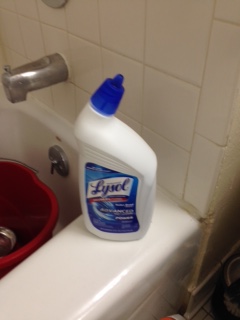
Common acids in the house include toilet bowl cleaners (which contain some hydrochloric acid, HCl); industrial uses of acids include making fertilizers, dyes, in photography and explosives manufacturing to name a few.(Ref.2,3)

IMG_2422IMG_2474IMG_2473

Bases are usually soapy to touch and some are very corrosive. All inorganic bases have a cation and an anion like acids, but the cation is not a hydrogen ion but usually a metal ion like lithium, sodium, potassium, etc. The anion is always a hydroxyl ion which is an OH negative ion shown like this:OH

Common bases are ionic like acids and are written as sodium hydroxide, NaOH, potassium hydroxide,KOH, calcium hydroxide,Ca(OH)2 etc but exist actually as shown for acids above, viz.,

NaOH →  Na+ OH 

KOH →       KOH–  

Ca(OH) →   Ca++   2OH–     

Again, the greater the dissociation of hydroxyl ions, the stronger is the base.  So bases are characterized by the number of hydroxyl ions, OH–  and end with hydroxide.  You can calculate the pOH of the base just like for the acids.  Again, imagine you have a .01M solution of sodium hydroxide, Na+ OH  and so the pOH of the base will be:

-(log 0.01) = -(-2)= 2.  Now pH + pOH =14, hence pH = 14-2=12.   pH of acids is below 7 and pH of bases is between 7 and 14.  Strong bases will have more hydroxyl ions and will be around 11 or 12 or even higher. Water is neither a base nor an acid and is neutral, so the pH will be around 7.

Bases like sodium hydroxide is used for making soap.  Potassium hydroxide is used in alkaline batteries and calcium hydroxide is used in bleaching powder and as an antidote for food poisoning.(Ref.4)

Next week, we will look at the reactions between acids and bases and study the resulting products.

Activities for Middle School Teachers:

Compare words like’volume’ , ‘mole’,’rational’ and ‘irrational’, generally used in the English language and in Science and Mathematics.  Let students find out other words that have different meanings inside and outside the field of Science/Mathematics, like ‘litmus test’.

pH uses logs.  Study logs or what is called logarithms.   Logs are to the base 10 ; hence log 10 is actually 1.  This can also be stated as the exponent of 10 is 1 when the base is 10 or 101   =10.  Log 100 =2, because the exponent of 10 has to be 2 to equal 100.  (Before calculators were invented, log tables were used to do complicated multiplication, division, and exponential calculations.)

Using different molarities for hydrogen ion concentrations in acids and hydroxyl ions in bases, calculate the pH of different acids and bases.

Find out more about Avogadro and Avogadro’s Number.

Why do gardeners worry about the pH of the soil? What plants need acidic soil and why?

Nuggets of Information:

Hydrochloric acid,HCl, mixed with nitric acid.HNO3, is called aqua regia, literally meaning ‘royal water’.  This mixture is used in metallurgy to dissolve metals like gold Au, and platinum, Pt.(Ref. 5)

HCl is also known as muriatic acid and used to clean concrete. (Ref.2)

Did you know that  when you usually eat on time and  then sometimes you don’t, your stomach growls?  The growling is actually the secretion of hydrochloric acid, HCl, inside the walls of your abdomen getting ready to digest the food that should be there! (Ref.2)

Battery Acid in cars is sulfuric acid, H2SO.(Ref. 6)

What is a mole? Normally a mole means an animal that lives underground. But in chemistry, a mole is a number like a dozen(12) or a gross(144).  A mole is really a unit of measurement; it is a number that has the same number of particles found in 12.0 gms of Carbon-12= Avagadro’s number. This number is 6.023x 10²³ .  1 mole of carbon-12 has 6.023x 10²³ atoms.  1 mole of teachers = 6.023x 10²³(Ref.7) , 1mole of any element will be its atomic mass and will have 6.023x 10²³atoms.

Calcium Hydroxide is also known as slaked lime, sodium hydroxide is called caustic soda or lye.  The latter is used in petroleum refining, in medicines and in the manufacture of rayon. (Ref.4)

A base is also called an alkali.  The word ‘alkali’ is derived from Arabic, since the ancient Muslims in the Middle East were well-known chemists. Al Qali means the ashes.(Ref. 8)

Another well-known base/alkali is ammonium hydroxide written as NH4OH , but exists in the ionic form NH4+ OH like all the other bases and acids.  Dawn, a  dish washing liquid, contains ammonium hydroxide, or ammonia as it is commonly called.   Ammonium Hydroxide is used in the cosmetic industry,  and also as a spot and grease remover.(Ref.4) 

Ammonia and water  is in equilibrium with ammonium hydroxide :

NH+  H2O  →       NH4OH

‘Smelling salts’ have existed since the time of the Romans and was used by women whenever they had a fainting fit.   It contains water and ammonia which is essentially ammonium hydroxide (above equation). Even today, athletes in football and hockey tend to use ‘smelling salts’ to give them some boosts of energy.  The fear is the abuse of this base.(Ref. 9)

A few years ago there was a major controversy with pink slime, the addition of ammonium hydroxide in meat.  McDonald’s insisted that they had stopped its use in their products.(Ref. 10)

Don’t forget, sodium hydroxide is  used to unclog drains and is present in the famous household product, Drano.(Ref.11)

Indicator liquids change color in acidic or basic solutions; most are organic weak acids themselves.   Phenolphthalein  turns bright pink in basic solutions and is colorless (original color) in acidic solutions.   Red litmus paper turns blue in basic solutions and blue litmus paper turns red in acidic solutions.  There is also a universal indicator paper that changes color based on the pH of the solution.(Ref. 12 )

Acids also have the ability to react with metals like zinc, magnesium to produce hydrogen gas. (Ref. 13)


References:

  1. http://chemistry.about.com/od/acidsbase1/a/strong-acids-list.htm
  2. http://www.ehow.com/info_8049843_common-uses-hydrochloric-acid.html
  3. http://www.preservearticles.com/201012261679/common-uses-of-acids.html
  4. http://www.preservearticles.com/201012261681/uses-of-bases.html
  5. http://dictionary.reference.com/browse/aqua-regia
  6. http://chemistry.about.com/od/chemicalcomposition/f/What-Is-Battery-Acid.htm
  7. http://chemistry.about.com/cs/generalchemistry/f/blmole.htm
  8. http://www.20000-surnames.com/etymology_dictionary_A/origin_of_the_word_alkali.htm
  9. http://www.todayifoundout.com/index.php/2015/01/smelling-salts/
  10. http://wafflesatnoon.com/pink-slime/
  11. http://sodiumhydroxide.weebly.com/uses.html
  12. http://chemwiki.ucdavis.edu/Physical_Chemistry/Acids_and_Bases/Case_Studies/Acid_and_Base_Indicators
  13. Hein,Morris, and Arena, Susan, Foundations of College Chemistry p.374 (John Wiley and Sons 2007)

Science makes Sense Week 12: Chemistry and Social Justice-Coal and Coltan mining, coal mine disasters,black lung disease, gorillas ,guns and a ghastly life..

November 8, 2015

Just before the U.S.Presidential elections in 2008, while the Republican and Democratic candidates were sparring on various issues, there was a curious agreement on one.  Both candidates supported using coal as an energy source and called it ‘clean coal’.   A Los Angeles Times’ article during this period aptly called this phrase ‘Orwellian’. (Ref. 1)

A student with a little chemistry knows that coal is mostly carbon,C, and when you burn carbon, voila, you get carbon dioxide. Coal is also a fossil fuel.   Week 8, we have already talked in detail about the oxidation reaction of carbon compounds like hydrocarbons.  More than 50% of our energy resources comes from coal,(Ref. 2) so we are adding considerably to the carbon content in the atmosphere and contributing to climate change burning coal, besides depending more and more on automobiles and planes.(Week 8)

Years ago, it was hazardous just to go down the coal mines.  (Even today, in certain parts of the world, the conditions at work inside mines are horrific and dangerous.) (See Nuggets of Information)   Lack of oxygen and long hours inside the mines is unhealthy; add to that the inhalation of small particles of coal dust causing lung diseases and explosions.   Mine areas are constructed with minimal reinforcements and there is always the danger of collapsing of structures and trapping miners who could die a slow and terrible death underground.(Ref. 3)  Even till  the early part of the 20th century miners carried canaries with them in cages.  If the canaries died, they knew there wasn’t sufficient oxygen for the humans and the canaries had died inhaling carbon monoxide,CO.(Ref. 4)

2C  +  O2    →    2CO

C  +  O2    →         CO2

This is partial oxidation of Carbon, C.  Complete oxidation of C leads to carbon dioxide, as shown in the second equation. There is also sufficient methane in the coal mines as well.  During the coal manufacturing process mercury, Hg,  and uranium, U, are by-products.(Ref. 5)   Mercury can lead to renal, gastrointestinal and neurological,toxicity,(Ref. 6) while uranium is radioactive and can affect human cells.  As you can see,there is no part of the coal mining process that is clean.

Today it is not just coal that is being mined.  There are  areas in the Congo where ‘Coltan’ mining takes place.  This is short for Columbite and Tantalite, compounds of Niobium and Tantalum.(Ref. 7) These two elements, Niobium,Nb, and Tantalum,Ta, are in the same Group and below Vanadium, V, in the Periodic Table.  They are part of the Transition Elements, also called rare metals.  The transition metals are where the 10 electrons in the ‘d’ shell are being filled. (Ref. 8)  

What is so special about these two elements?  Tantalum, or Ta, when powdered with its oxide is used in mobile cellular phones and other electronic devices as a capacitor. (Ref.9) A capacitor stores electrical charge and controls the flow of electrical current, also called a condenser.(Ref.10)  Ta is extremely good at conducting heat as well as electricity, making it a favorite metal to use in small electronic devices (Ref.9)  Nb, on the other hand is not used in electronic devices, but is very widely used in making stainless steel, in the construction of space ships and for making jewellery.(Ref.11)  It just happens to be found alongside Tantalum as Coltan.

The mining process in the Congo is not as tedious and hazardous; however the conditions for the workers is deplorable. Teenage and child workers are usually working long hours in the mines. Rwanda which is next door is involved in a Civil War with the Congo, fighting for rights on the Coltan mines, exploiting and killing people in the process.  In addition, the digging of mountains and areas in that region is affecting the gorilla and other wildlife population considerably.  But there is a lot of money that can be obtained from mining Coltan, so people, the army, the rebel forces are rushing in to grab what they can, extracting money from the workers. (Ref.12) This reminds one of the Gold Rush days of North America in the 19th century.  There have been attempts made by electronic companies that sell smart phones to look for other sources in the world for Coltan. However war-torn Central Africa still supplies one-fourth of the world’s supply and the rest comes from the Amazon area in South America, and maybe parts of Australia. (Ref.13) Unfortunately, conditions are similar to what is happening in the Congo; only the venue has changed.

Meanwhile, the craze for the latest smart tablet or phone is never-ending as well as our thirst for fossil fuel energy from coal.  We as a society have to decide if human rights violations, health of humans and the degradation of the environment and fauna and flora is worth this madness for the latest technological marvel or our continuing dependence on fossil fuel.  Can we as a species arrive at a meaningful and sustainable solution?

IMG_2229IMG_2382

Activities for Middle School Teachers:

Watch the movie by John Sayles about West Virginia coal miners called “Matewan’.(Ref.14)

Let the students look at coal mine disasters in the 21st century, throughout  the world.

Study the gold rush, oil rush and today’s Coltan rush and document the similarities and differences.

Do an experiment studying capacitors.  Capacitors store electrical energy and springs store mechanical energy, graph charge versus voltage for capacitors and force versus displacement for springs. (Ref. 15 )

Tantalum and Niobium along with Cobalt and few metalloids are called rare metals, and the  rare earth elements are the Lanthanides and Actinides in the Periodic Table. (Ref.16,17)

Compare and contrast properties and uses of these two: rare metals and rare earth elements.

The origins of the names for Tantalum and Niobium comes from Greek mythology.  Find out the significance of this.

Nuggets of information:

This year,2015, marks the bicentenary of the Safety Lamp created by Humphrey Davy and Stephenson who both independently worked on a lamp for miners.  Both fought for rights for the discovery, but the lamp was named after Sir Humphrey Davy, called the Davy Safety Lamp. The flame in the lamp changed color if methane gas was found in the mines and was carried by miners inside the coal mines. (Ref.18)

The 5 largest coal mining/producing areas in the U.S. are Wyoming with almost 40% of the total U.S. production; next is West Virginia (12%), followed by Kentucky (8%) and Illinois and Pennsylvania (5% each). (Ref.19)

If you look at the number of coal mine disasters in West Virginia over a 110 year period, from the late 19th century till recently, one sees that there is an average of more than one mine disaster per year!  Most of them are because of some sort of explosion in the mine.(Ref.20)  The latest well-known mine disaster there occurred in 2010 in the Upper Big Branch Mine  owned by Massey Energy where 29 miners lost their lives and was due to methane gas leaking with resulting explosions. Compensation and law suits are still being settled.(Ref.21)

China, India, Japan, South Africa, Wales,to name a few countries, have had several coal mine disasters over the years.(Ref.22) There is also child labor involved in some countries, especially in Northeast India even today. Several non-profit agencies are trying to find opportunities for children to avoid the dangerous and often fatal work in India.(Ref.23)  BP , the oil company states that India, US, Russia, China and Australia have the highest coal reserves.(Ref.24)

Mountain top removal is the latest way of looking for coal, especially in the Appalachian Mountains in the Eastern United States. This strips the land causing water shortages, the land is laid out to waste and frequent floods and health problems affect the people who live there. (Ref 25)

Black lung disease was very common  before the 70s in the US. This is a disease that is usually found in miners with prolonged exposure to coal dust.  One would have thought with the regulations imposed after the 1970s, cases of this disease would disappear.  Unfortunately, many of the 29 men who died in the mine disaster from West Virginia suffered from this disease.(Ref.26)

There is mining of not just coal and Coltan in the world that causes environmental and human rights violations. There are mines for manganese, gold, silver, copper tin and diamonds. and in all these cases there is small-scale and large-scale mining.  There are jobs created but there are many diseases, lack of clean water and all the other problems mentioned above(Ref.27)

One meaningful way to lower the demand for more Coltan is to recycle old, unused electronic devices; many neighborhood programs conduct such recycling programs.

Since coal is not really clean energy, we need to be. investing more in solar and wind energy here in the U.S.

References:

1.http://articles.latimes.com/2008/oct/07/opinion/ed-coal7

2.http://www.democracynow.org/2008/10/7/can_coal_be_clean_a_debate

3.http://www.spike.com/articles/g1dc77/coal-the-potential-hazards-of-working-in-a-coal-mine

4.http://io9.com/why-did-they-put-canaries-in-coal-mines-1506887813

5.https://answers.yahoo.com/question/index?qid=20110610214804AAHWiZy

6.http://emedicine.medscape.com/article/1175560-overview

7.http://www.custompcblog.com/industry-news/what-is-coltan-tantalum

8.Hein, Morris & Arena, Susan, Foundations of College Chemistry,pp.215,6 (John Wiley and sons, 2007)

9.http://www.rsc.org/chemistryworld/podcast/Interactive_Periodic_Table_Transcripts

/Tantalum.asp

10.http://www.thefreedictionary.com/capacitor

11.http://www.chemicool.com/elements/niobium.html

12.http://www.bing.com/videos/search?q=blood+coltan+documentary&FORM=VIRE1#view=detail&mid

=889A75174CAC409A3313889A75174CAC409A3313

13.http://www.icij.org/projects/coltan/five-things-you-need-know-about-coltan

14.http://www.matewan.com/History/movie.htm

15.http://dev.physicslab.org/Document.aspx?doctype=3&filename=DCcircuits_CapacitorProperties.xml

16.http://web.mit.edu/12.000/www/m2016/finalwebsite/elements/raremetals.html

17.http://www.chemistry.patent-invent.com/chemistry/rare_earth_elements.html

18.http://www.theguardian.com/science/the-h-word/2015/jul/22/humphry-davy-lamp-controversy-history-science

19.http://www.eia.gov/tools/faqs/faq.cfm?id=69&t=2

20.http://www.wvminesafety.org/disaster.htm

21.http://www.huffingtonpost.com/2011/12/06/upper-big-branch-report-findings_n_1132462.html

22.http://www.hurriyetdailynews.com/worlds-worst-coal-mine-disasters.aspx?

pageID=238&nID=66447&NewsCatID=359

23.http://www.bing.com/videos/search?q=young+adult+literature+on+coal+mining&FORM=VIRE4#view=detail&mid

=8660717F11AD62FE3DE38660717F11AD62FE3DE3

24.http://www.mbendi.com/indy/ming/coal/p0005.htm

25.http://earthjustice.org/features/campaigns/what-is-mountaintop-removal-mining

26.http://loe.org/shows/segments.html?programID=11-P13-00021&segmentID=1

27.http://kids.mongabay.com/lesson_plans/lisa_algee/mining.html

Science Makes Sense, Week 11: Organic Chemistry, isomers,stereo and structural isomers, cis-platin, cancer treatment and my eye!

November 1, 2015

Siddhartha Mukherjee in his Pulitzer Prize-winning biography of cancer called The Emperor of All Maladies, talks about the efficacy of using cis-platin or cis-Platinum to cure certain specific types of cancer.  Cis-platin chemically reacts with DNA making these DNA -damaged cells unable to duplicate their genes, halting the spread of the cancer.(Ref. 1)  Today I will talk about the structure of these compounds using simpler models to illustrate stereo and structural isomers.

What are isomers?  An isomer of a compound has the same chemical formula but different arrangement of atoms.  Week 7, I talked about these isomers briefly but today we will look at more examples.  First we will look at the structure of cis and trans-platin.  Unlike organic chemistry molecules, these molecules do not have carbon as the central atom.  Platinum,Pt from the transition metal series, is the central atom with 4 bonds: two are with ammonia molecules (NH3) and two are with chlorine (Cl) atoms as shown.  Notice the cis structure has both Cl atoms on the same side of the Pt, whereas the trans structure has the Cl atoms on opposite sides of the Pt. (First picture) 

Week 7 we saw isomers of cis-2-butene and trans-2-butene. The nomenclature of these organic compounds is not too difficult to understand. The carbon compound is an alkene with general formula CnH2n where n=4, so it is a butene. Since the double bond is between the second and third carbon atom it is called 2-butene.  The relative positions of H (hydrogen), CH3(methyl) decides if it is a cis or trans 2-butene.  When the methyl groups are on the same side, it is called a cis isomer and when they are on opposite sides , it is called a trans isomer.(Look at the picture from Week 7)  Wherever there is a difference in geometry of atoms or group of atoms  in space, the isomer is called a sterioisomer.   Note that the chemical formula is still the same for cis and trans-butene viz., C4H8.  Cis and trans isomers are usually found around double bonds where there is limited rotation, but also found around heavy metals like Platinum Pt, as well.

In Week 7, we noticed the straight and branched chain with butene which caused two more isomers. These are called structural isomers, since the arrangement of the atoms has changed. Here it is not the spatial arrangement, but the structural  arrangement of carbon atoms that is different.  Saturated carbon atoms, like alkanes also  exhibit structural isomerism.  Stereo-isomerism may be absent since there is free rotation around the C-C bond unlike in the case of a C=C bond in 2-butene which restricts rotation.

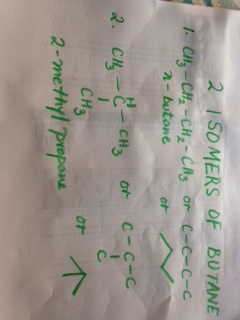
Butane has two structural isomers: A straight chain of the 4 carbon atoms gives you butane, but when they branch, you get isobutane  or 2-methyl propane.(Second Picture)  As the number of carbon atoms increases, the possibility of more isomers exist.  (The best way to understand isomers, is to actually make the models with ball and stick kits or other kits that are available.   You could also construct them using toothpicks and marshmallows, cherry tomatoes or other objects that stick on to the toothpicks).   Remember all the possible structures are called isomers akin to saying, “We are 4 siblings or I have 2 sisters and a brother”.  In other words, butane has 2 isomers or normal or straight-chain butane has 1 other isomer that is a branched chain.

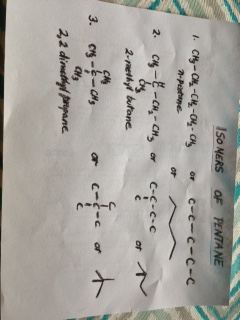
How many isomers does pentane have?  Again, start with  a straight chain and see how many branched chains you can form.  You see only 3 isomers of pentane: n-pentane, 2-methyl butane and 2,2-dimethyl propane.(Third picture)  Hexane has 6 isomers well illustrated in the U-tube example.(Ref. 2).  When we get to heptane there are 9 isomers.(Ref. 3).  Note the stick model without showing the C or the CH3, H atoms attached to the C shown in the second, third pictures. This will be helpful later when we talk about cyclic hydrocarbons without indicating all the C, H atoms but just showing the geometric stick figure or closed polygons.

Why is it important to talk about isomers? Many isomers of alkanes and other organic compounds play a very important part in our daily life. Iso-octane is a very vital component of fuel for automobiles.  We just saw how cis-platin is invaluable in the successful treatment of certain kinds of cancer.  But one of the most exciting applications of cis and trans isomers is what happens in less than a picosecond (1×10-12of a second) when we see something!  Light reflected from objects undergo a chemical change, and the brain makes sense of the visual information to create an object.   The eye is somewhat like a camera.  The pupil allows light to enter the eye, focused by the lens and strikes  light-sensitive detectors in the retina which is at the back of the eyeball.  The light-sensitive detectors are called rods and cones (shaped that way). The cones provide color information while the rods are extremely sensitive detectors of white light and help with night vision.  The rods when hit with light, 11 cis -retinal (a chemical in the retina) isomerizes to all trans-retinal.  So every time we see, a small step in the process utilizes isomers.(Ref.4) The whole process of isomerization might take 200 femtoseconds to 1 picosecond! (Ref.5)

IMG_2367IMG_2373IMG_2370

Activities for Middle School Teachers:

What is a femtosecond? It is 1×10-15 of a second.  Let students learn all the various names for these minute time elapses, like pico, nano etc. These prefixes can also be applied to other measurements like length, volume, mass.

To find isomers for higher alkanes, students need to carry out the following operations:

  1. First write the structure of the longest chain .
  2. Next write the possible structures of the branched chain with one C removed  and placed at various positions attached to a C
  3. Next write the possible structures of the branched chain with two C removed
  4. Repeat this process till you have no duplicates.

Look for cis and trans isomers among alkenes and alkynes. 2-butene was the first to exhibit these isomers.Go up to n=10 to explore these isomers. Also calculate the straight chain and branched chain isomers with alkenes and alkynes from n=2 till n=10.

The word, ‘iso’ implies same. Look for other words that start with iso, eg., isotherm, isobar, isometric, isotopes. What do they mean?

Today we use words like cis- gender and trans-gender. Knowing what you do about the meaning of cis and trans isomers can you see the appropriateness of these definitions for people and their preferences?

IMG_2371

Nuggets of Information:

Enantiomers are another kind of stereo-isomers. These are non-superimposable structures that  have the same chemical formula, but are mirror-images of each other. (Fourth Picture)  A methane molecule where three of the H (hydrogen atoms) are replaced by Cl(chlorine), F(fluorine), and Br(bromine)atoms respectively, has 2 enantiomers.(Ref.6)

The carbon C atom in the center of these enantiomers which have four different atoms attached are called the chiral center or the stereogenic center. (Ref.6)

Acute promyelocytic leukemia (simply stated, cancer of the white blood cells, also known as ACL), has been effectively treated using a trans-isomer this time along with chemotherapy.  The isomer is called trans-retinoic acid.(Ref.1)  Retinoic acid is a 19 carbon organic acid (while vinegar is a one carbon organic acid) also known as Vitamin A acid. (Ref.7)

There are 3 kinds of structural isomers. The first involves straight chain and branched chain carbon compounds. The second is seen where there are double or triple bonds in the carbon compound and will depend on the position of the unsaturated bond.  The third will involve entirely different compounds with the same chemical formula, like an ether and an alcohol which can both contain carbon, hydrogen and oxygen atoms.(Ref. 8)   As we study more organic chemistry, the third isomer will make more sense!

Isomers are part of the world of big protein molecules in biochemistry; no wonder so many isomers play a role in medicine and naturally occurring substances like α- and β- glucose. Some of these proteins are so large and bulky that they change their shapes causing isomers that are called topoisomers. (Ref. 9)

The role of isomers is critical in what we can or cannot eat. Starch, found in corn, rice, wheat, potatoes is the main source of food for many cultures. But cellulose which has a similar structure, is inedible for humans and most animals but is a strong fibre . Both starch and cellulose are polymers of the monomer glucose, with just a difference in the arrangements of each monomer. (A polymer is many units of the same unit; here it is a glucose unit; a cyclic arrangement of carbon and hydrogen atoms, which is the monomer.)  The monomers of one is arranged like a mirror image, viz., an enantiomer of the other. (Ref. 9,10)

References:

  1. Mukherjee, Siddhartha, The Emperor of All Maladies(Scribner, 2010)
  2. https://www.youtube.com/watch?v=oUaXduj3xPM
  3. https://www.youtube.com/watch?v=sdAUQrRbwBY
  4.  http://www.chemistry.wustl.edu/~edudev/LabTutorials/Vision/Vision.html
  5. http://www.sciencemag.org/content/310/5750/1006.short
  6. http://www.introorganicchemistry.com/stereochemistry.html?ckattempt=1
  7. ttp://pubchem.ncbi.nlm.nih.gov/compound/Retinoic_acid
  8. http://www.compoundchem.com/2014/05/22/typesofisomerism
  9. http://www.madsci.org/posts/archives/2006-12/1167255095.Bc.r.html
  10. http://pslc.ws/macrog/starlose.htm

Science Makes Sense, Week 10: Glass, silicon, sandy beaches, fiber optics, piezoelectricity

October 25, 2015

William the Franciscan Friar who has come to investigate a murder in the monastery, is busy getting his glass lenses ready to help him with his failing eyesight.  Humberto Eco, in his classic  “The Name of the Rose” explains with great detail about life in the 14th century where he imagines the origins of using convex glass circles to create early eye glasses. (Ref.1)

Of course glass was discovered long before the 14th century.  During 1500  BC, the first creations with glass is credited in ancient Mesopotamia, modern-day Syria.  When lightning struck sand, a brittle shiny object called obsidian was formed.  People in and around Mesopotamia shaped it as knives and sharp objects for hunting.  Glass making was tedious in those days using clay pots and long hours working with sand.  The invention of a glass blower in 30 BC changed glass production considerably allowing different shapes and forms to be created now.(Ref.2).  However, the first recorded uses of glass-like material like obsidian from volcanic areas and fulgurites (lightning striking sand) is from 7500 BC.(Ref.2)

What is glass?  Since it is created from sand which is plentiful in beaches, the main element is Silicon, Si in the form of compounds called silicate SiO44- (Ref.3).  Both Si and O are the two most abundant elements on earth.  Sand contains quartz, made up of an orderly arrangement of SiO44-  anions in a tetrahedral shape combining with other Si and O ions to have the general formula SiO2, silica and is crystalline.  Glass has the same formula, but it is amorphous and the arrangement of the anions is a short range.  The process of creating glass sometimes involves adding sodium carbonate Na2CO3 to sand and heating it to a high enough temperature and cooling it rapidly.(Ref.4) 

Glass manufacture needs three components: the former, flux and stabilizer.  The former is silica or SiO2, and alone it needs very high temperatures to melt and therefore a flux e.g., oxides of alkali metals like Na2O (soda/sodium oxide) or K2O (potash/ potassium oxide) or Li2O (Lithia/ lithium oxide) is added.  Even though now the melting point temperature is lowered, the resulting glass may be water-soluble and of low durability.  A stabilizer like CaO or BaO or MgO or PbO,( oxides of calcium, barium magnesium or lead; also called lime, baria, magnesia, litharge respectively) is also added. Common glass (for windows, jars, bottles, bulbs) contain SiO2 as former, Na2O  as flux and CaO as stabilizer.(Ref.3)  As shown in the above paragraph, sometimes Na2CO3  is used as a flux.

Glass is neither a solid nor a liquid, since the arrangement of the anions and cations are almost like a liquid but it has an appearance of a solid!  Molecular physics and thermodynamics (behavior under different temperatures) are still not clear but here are some observations:

Many solids have a crystalline structure on a microscopic scale just like Na+Cl.  The ions/molecules/atoms are arranged in a regular lattice and when the solid is heated, they vibrate until the melting point and the crystal structure breaks down. The ions/molecules/atoms flow and the solid to liquid state is a sharp transition, which explains the fixed melting point for so many solids.  This is called a first order phase transition.  The density also changes distinctly.

Let us look at the reverse process; from liquid back to the solid state.  As it cools, the viscosity (also called resistance to flow) increases, which is understandable since the ions/molecules/atoms are moving closer together.  However, this increase in the viscosity could prevent crystallization.  And it could keep cooling below the freezing point called supercooling, and may never crystallize.  The viscosity keeps rising and forms a thick syrup and finally an amorphous solid.  The molecules will have a disorderly arrangement, almost glass-like?

Therefore, glass could be considered a super-cooled liquid with no first order phase transition, but a second order phase transition; between super-cooled liquid state and the glass state, not as dramatic as the liquid to crystalline solid state.  The temperature at which this glass transition occurs depends on how slowly it is cooled.

So to summarize we have three types of molecular arrangements:

  1. Crystalline solids- ions/molecules/atoms are ordered in a regular lattice.
  2. Fluids- ions/molecules/atoms disordered and not rigidly bound.
  3. Glasses- ions/molecules/atoms disordered but rigidly bound. (Ref.5)

The jury is still out on the exact definition of glass!

IMG_2362IMG_2359

Activities for Middle School Teachers:

Make glassy material using some sugar syrup; also make crystalline candy with sugar syrup and study the difference in the procedure.

Silicon is present in many semi-precious stones including quartz; list the elements that cause different colors/ semi precious stones.(Ref.6)

Students can study architectural wonders in the world constructed with glass: Louvre in Paris France and La Estancia Glass Chapel in Cuernavaca, Mexico are examples.(Ref.7)

Study the different civilizations like the Mayas and in Mesopotamia and look at the role of obsidian, glass during those periods. (Refs.8,9)

Nuggets of information:

In 1664, an Englishman, Mr.Ravenscroft added small amounts of lead oxide (PbO) during the glass making process to create brilliant glass.  This led to the creation of crystal bowls and goblets.  Different grades of glassware can be created by adding different oxides:

  1. When boron oxide is added, laboratory glassware is produced that withstands high temperature.
  2. When aluminium oxide is added the glass withstands even higher temperature to keep on stove tops.
  3. High content (almost 100%) silica glass, resistant to thermal shock and chemical attack is used to make spacecraft windows, fiber optics. (Ref.3)

Fiber optics or optical wave grids are today’s communication technology that has replaced the humble copper wire.  A single strand of glass fiber, coated with a protective plastic resembles a human hair.  The glass fiber has an inner core of ultra-pure fused SiO2 coated with another SiO2 glass to act as a light reflective barrier.  Lasers are used to convert electrical impulses and sound waves to pulses of light that travel through the inner core.  1lb of glass fiber transmits the information that would formerly require 200 tons of copper wire!  These fiber optic cables criss-cross our entire earth. (Ref.3)

Cooks who create desserts and work with sugar probably know how to create glassy shards of brittle concoctions using the super-cooled process with sugar syrup, a liquid.  This same sugar syrup can be used to make crystalline candy.

In old churches, the glass is found to be thicker at the bottom of the window and people thought glass must be a liquid and flowed from top to bottom over the years.  Actually this is not true.  In Medieval times, panes of glass were often made by the blown glass method.  A lump of molten glass was rolled, blown, expanded and flattened.  Finally it was spun into a disk, which made it thicker at the edges.  When installed, the thicker side was placed at the bottom side of a window-pane. (Ref.4)

Si, like C, (being in the same Group in the Periodic Table) forms a lot of different covalent bonds with O.  Apart from quartz, talc, there are different kinds of naturally occurring asbestos that contain silicates. (Ref.4)

One of the most interesting properties of quartz is piezoelectricity, which means that when you apply pressure to a crystal of quartz, the orderly arrangement of atoms/molecules/ions is disturbed and the crystals conduct electricity.  The opposite is also true; when you apply electricity to quartz crystal, there is a shift in the position of the atoms/molecules/ions. These principles are used in a quartz watch that keeps perfect time, as well as in voice-recognition software that we use frequently. (Ref.10)

Glass containers are considered the best for storing spices and other foods.  Glass, especially clear glass in a dark cupboard or dark-colored glass, stores herbs well and does not impart any odor to the food, like plastic.

Today, most supermarkets sell liquids in plastic or paper coated with plastic containers that were previously sold in glass containers. The one place where glass use continues is in the making of all kinds of mirrors. (Ref.11) and in the manufacture of LED (light emitting diodes) lighting.(Ref. 12)

References:

1. Eco, Humberto, The Name of the Rose, (Bompiani, 1980, English,1983)

2. http://www.texasglass.com/glass_facts/history_of_Glass.html

3. http://www.chemistryexplained.com/Ge-Hy/Glass.html

4. http://www.science.uwaterloo.ca/~cchieh/cact/applychem/silicate.html

5. http://mineral.eng.usm.my/web%20halaman%20mineral/silica%20sand.pdf

6. http://math.ucr.edu/home/baez/physics/General/Glass/glass.html

7. http://omnigp.com/20-beautiful-glass-buildings-world/

8. http://authenticmaya.com/Obsidian.htm

9. http://www.historyofglass.com/

10. http://www.explainthatstuff.com/piezoelectricity.html

11.  http://www.ehow.com/how-does_4569519_how-mirrors-made.html

12. http://www.bizjournals.com/prnewswire/press_releases/2012/10/04/CG87004


Science Makes Sense, Week 9: Common Salt, Sodium Chloride, ionic bonds,crystallography, La Gabelle and Dandi March.

October 18, 2015

Pliny the Elder, a Roman statesman and scholar (first century) is supposed to have come up with the famous saying Cum grano salis or more accurately Addito salis grano (Ref.1) which means ‘with the addition of a grain of salt’ questioning a statement’s veracity. It is possible that expressions with salt have been there  even before the time of the Bible. In the Thirukural , a book of 1330 couplet verses of 4 and 3 words in the Tamil language, (Time period:two hundred years BC to 8th century?), there is a reference to salt almost at the end!  At the tip of India, in a city called Kanyakumari where the Bay of Bengal meets the Indian Ocean and the Arabian Sea, there is a splendid statue of Thiruvalluvar, who is credited with the poetry of Thirukural. (See third picture)

Common salt or table salt has the formula NaCl in Chemistry, and it is called sodium chloride.

IMG_2355

IMG_2358Let us look at the structure of sodium chloride. We have already looked at covalent bonds where there is sharing of electrons, and we have seen hydrogen bonds that are weak bonds between oxygen and hydrogen in compounds like water. Now we will look at a third kind of bond here. Inorganic compounds form bonds in a different manner than organic compounds where electrons are shared. Inorganic compounds form ionic bonds, which involves a transfer of electrons from one element to another element or group of elements. Many of the elements in the Periodic Table can form these ionic bonds. Today we will look at the simplest ionic bond involving two elements : sodium and chlorine forming the compound sodium chloride. Such compounds are called binary compounds.

When a sodium atom reacts with a chlorine atom, the sodium atom gives up one electron and becomes a positive ion(cation),the sodium ion,Na+. (All atoms are electrically neutral)  The chorine atom accepts the electron and becomes a negative ion(anion), the chloride ion,Cl

The bond is actually the attraction of oppositely charged particles :Na+Cl, so technically it is not a bond like the covalent bond  where two shared electrons constitute a bond. Since these are charged particles, a solution of sodium chloride or molten sodium chloride will conduct electricity. In fact, all ionic compounds in the molten state or in a solution will be conductors of electricity.Other properties of ionic compounds include high boiling and melting points, solubility in water (for some ionic compounds) and defined crystal shapes.(Ref. 2)

What is a crystal? It is a definite arrangement of atoms, molecules or ions in a periodic pattern in three dimension. (Ref.3) Let us look at a crystal of sodium chloride or more accurately Na+Cl–   

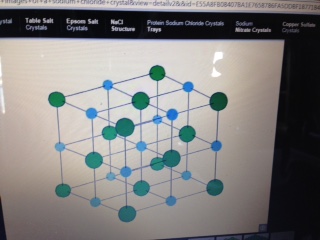
Every sodium ion is surrounded by 6 chloride ions and each of the chloride ions are surrounded by six sodium ions as shown in the second picture. The crystal structure of sodium chloride is cubic.The larger green circles in the second picture are chloride ions and the smaller blue circles are sodium ions. Why are the sizes different?

First let us look at the position of Na in the Periodic Table. It is the 11th element in the Periodic Table. and then it loses an electron to become a cation,Na+.  It loses the outer electron in the second shell and also has one more proton than electron and the attraction to the nucleus is more and hence becomes much smaller.  Meanwhile  the chloride ion,Cl.has 18 electrons and only 17 protons, nuclear attraction to each electron is decreased and allows the Cl atom to expand as it forms the Cl   This makes the Cl  to be considerably larger than a Na+.(Ref.4)

Many ionic compounds form crystals and the order and arrangement of the atoms can be studied by crystallography. Using X-rays, or neutrons , a single crystal of any ionic compound is studied; a pattern of spots are seen and using mathematical models, the arrangements of the atoms/ molecules/ ions can be deduced.(Ref.5)  Just as visible light is part of the electromagnetic spectrum, X- rays with much shorter wavelength are part of this same spectrum. (Ref.6)IMG_1795

This ionic compound, sodium chloride, has played a critical role in the history of the world.Before industrialization and definitely before refrigeration,salt was a much-needed commodity for food preservation. We will talk about the spice trade where wars were fought over the pepper trade, but everyone forgets the importance of salt, which is fundamental for living and caused upheavals in many countries.

When the British ruled India for over 200 years, they imposed a salt tax and made it very difficult for poor Indians to get their daily intake of salt In fact, there is evidence that it resulted in the death of many people due to a  lack of salt in their systems. Mohandas K Gandhi, the freedom fighter, who used non-violent methods to achieve India’s independence refused to buy salt from the British. He started a long march, called the Dandi March to walk to the seashore on the west coast of India to evaporate salt from the sea and use it instead.(Ref. 7)

In France, from the 14th through the 18th century, high salt taxes called la gabelle  were levied and caused a lot of anger and resentment among the people.(Ref.8) Even during the Civil War in the United States in the latter part of the 19th century, the South’s supply of salt was destroyed by the Union forces; tactics used to cripple the South’s effectiveness in the battlefield.(Ref.9)

No wonder so many sayings throughout the world mention salt, this small ionic compound called sodium chloride.

Activities for Middle School Teachers:

Students should have a discussion about sayings with salt in their cultures. It would be interesting to see how vital a role salt has played in our lives for so long.

Let students sharpen their idioms in English by thinking of all the sayings that are common using salt; eg, “rubbing salt to one’s wounds”, ” worth your weight in salt” etc.

Let students grow crystals of salt in the laboratory. let them examine the little crystals called seed crystals that may be found at the bottom of the beakers using magnifying glasses, what are their shapes?

Confluence of geometry and atomic arrangement: The Na+Cl–  crystal has perfect symmetry among all the 14 Bravais crystal lattice structures. (Students need to understand the different types of symmetry, mirror image symmetry, rotational symmetry etc.)(Ref.10) Here a=b=c and the angles are all equal to 900. Students could construct the 14 possible arrangement of atoms/molecules/ ions among the various crystal structures.

How did people look for salt long ago besides going to the salt water areas? Let students search for salt- water lakes all over the world as a geography project.

Students can read the following books about salt:”Men of Salt” by Michael Benanav,”Salt” by Neil Morris and “Salt” by Mark Kurlansky.(Refs.11,12,13) The third book is considered a must for anyone interesting in cooking/food.

Nuggets of Information:

Crystals of sodium chloride are also called halite crystals.

Why do some elements like to give up electrons and others prefer accepting them? Look at the Periodic Table and you will notice that elements on the left side of the Periodic Table in the first two groups and the Transition Elements give up electrons to attain the electronic configuration of Noble Gas elements like He, Ne, etc.that are before these elements These elements are called metals

On the other hand, Cl, Br, F as well as O, S, N etc, on the right-hand side of the Periodic Table, like to take electrons to attain the electronic configuration of the Noble Gas that follows them. These elements are called non-metals.

Even though salt, NaCl, is essential for all of us, today we are dealing with health problems because of too much salt in our foods especially processed foods like canned soups. Obesity, high blood pressure are some of the negative effects of too much salt in our diets.(Ref.14)

In Chemistry, when we use the word ‘salt’ we are not just talking about NaCl. A reaction between an acid and a base creates salt and water. There are many salts that are created this way and one of them  besides rock salt, (NaCl) can be used on the roadways to melt ice and snow during winter. This is a salt of calcium Ca, or magnesium, Mg.(Ref.15)

How does this salt melt the ice? It lowers the freezing point of ice when it mixes with the solid ice.

In Poland, there is a famous salt mine called Wieliczka where there are salt sculptures.(Ref.16)

Look at a tribute to Martin Gardner, who wrote regularly in the Scientific American; he was obsessed with symmetry and you can make a hexaflexagon! (Ref.17)

References:

1.Knowles, Elizabeth(editor),The Oxford Dictionary of Quotations (Oxford University Press,2001)

2. http://www.answers.com/Q/What_are_the_caracteristics_of_ionic_bonds

3. http://www.chemicool.com/definition/crystal.html

4. Hein, Morris & Arena, Susan, Foundations of College Chemistry, (John Wiley and sons, 2007)

5.http://www.acs.org/content/acs/en/careeres/college-to-career/chemistry-careers/cystallography.html

6. http://imagine.gsfc.nasa.gov/science/toolbox/emspectrum1.html

7. Sinha, Sarojini, A Pinch of Salt Rocks an Empire, (Children’s Book Trust, New Delhi,1985)

8. http://www.personal.psu.edu/sjh11/TCTaxBits/CuriousTaxFacts/SaltTax.shtml

9. http://www.encyclopediavirginia.org/Saltville_During_the_Civil_War

10. http://www.bing.com/videos/search?q=images+and+lectures+on+bravais+lattice&FORM=VIRE3#view=detail&mid=A84B06CECC099451B679A84B06CECC099451B679

11. Benanav, Michael, Men of Salt,(Lyons Press, 2006)

12.Morris, Neil, Salt, (London Franklin Watts,2005)

13. Kurlansky, Mark, Salt,(Penguin Books,2003)

14. Moss, Michael, Salt, Sugar and Fat,(New York, Random House,2013)

15. http://www.usroads.com/journals/p/rmj/9712/rm971202.htm

16. https://en.m.wikipedia.org/wiki/Wieliczka_Salt_Mine

17. https://www.youtube.com/watch?v=-6Q966FMVbQ

Science Makes Sense Week 8: Chemistry and Social Justice: burning of fossil fuels, climate change, carbon dioxide,methane levels and the monarch butterfly

October 11, 2015

There are many topics I will cover under Chemistry and Social Justice, but the excessive use and  burning of fossil fuels and its consequences seem the most urgent and grave topic for us all right now.

As some of you already know, those of us who live in the United States, know that we are dependent on fossil fuels for most of our energy sources. Today you will see through chemical reactions, what happens when fossil fuels/petroleum by-products are burnt. Petroleum by-products includes all the hydrocarbons, alkanes ,plus several derivatives that we use as fuels. When methane, ethane, propane or any alkane  burns, it combines with oxygen to give carbon dioxide and water. This is an oxidation reaction we studied (Week 2).The amount of carbon dioxide and water produced varies with the alkane; the higher the number of carbon atoms, the more carbon dioxide is produced:

CxHy + aO2 –> bCO2(g) + cH2O(g) ..                      

As you can see  x=b  which means that the higher the number of carbon atoms, the greater will be the molecules of carbon dioxide emitted; let me prove it to you with some examples:

CH4    +  2 O2      →   CO+  2H2O

2C2H6   +    7O2  →   4 CO2   +   6H2O

C3H8   + 5O2        →    3 CO2   +  4H2O

2C4H10  + 13O2    →   8 CO2   +  10H2O    

The ratio of alkane to carbon dioxide is 1:1 for methane, 1:2 for ethane and by the time you get to butane, the ratio is 1:4, which proves the statement before the equations, viz., the higher the alkane the greater the molecules of carbon dioxide produced. The amount of carbon dioxide produced has been increasing more rapidly in the 20th and 21st century, and there is a direct correlation between the increase in the amount of fossil fuels burnt in this period and the rise in carbon dioxide in parts per million (ppm)(Ref.1,3)

IMG_2330IMG_2346

The concentration of carbon dioxide levels has been monitored since the late fifties of the 20th century by scientists. However, air trapped in the snows of Antarctica have led to data on carbon dioxide levels for the past 160,000 years. These studies indicate that as the amount of carbon dioxide(CO2) increased, the global temperature increased as well. Now the levels of CO2 have remained fairly constant from the last Ice Age (100,000 years ago) until the Industrial Revolution which took place in the late 18th to mid 19th  century. However, a greater rise occurred in the 20th century (greater production and use of fossil fuels in developed and developing countries) and is rising even more dramatically in the 21st century where we have reached critical and dangerous levels.

How exactly does the increase in carbon dioxide lead to climate change? The CO2 rises to the atmosphere and forms an  invisible barrier or layer around the earth, almost like a glass in a greenhouse (the earth being the greenhouse) leading to the phenomenon we call ‘global warming’ or climate change.  CO2 and CH4 (methane; see next paragraph after this)  trap heat near the surface of the earth. While the sun’s radiation strikes the earth and warms it up and the warmed surface re-radiates this energy as heat, the gases absorb some of the heat which then warms the earth. (Ref.2,3) 

When considerable ice melts in the Arctic due to global warming, CH4 trapped  in the ice is released and this combines with the CO2 to add to more global warming and the vicious cycle is repeated ( Ref.4)

The warming of the earth for the last 10,000 years has been about 1 degree Centigrade (C) but since green house gases stay in the atmosphere for a very long time, in the last fifty years we have seen almost another degree rise in C! Many countries have agreed not to go beyond the critical 2 degree C rise. But if we continue at the rate at which we are using fossil fuels, doing nothing, the rise could go up by 6 degrees C!! Scientists have shown with their climate models that at a 4 degree C rise , sea levels will rise by several feet, 40% of the earth will be uninhabitable leading to over millions of displaced people and several species will get extinct.( Ref.4)

 The terrible hurricane called Katrina in New Orleans, the horrible floods along the east coast due to Hurricane Sandy, the recent severe drought in California, the resulting forest fires and the recent flooding in North Carolina, plus the rapidly melting ice layers in the Arctic and the Antarctic regions can all be attributed to climate change. This is directly as a result of our fossil fuel culture and the consequent rise in carbon dioxide production. The melting of the ice and the displacement of animals like the polar bear were vividly illustrated in the documentary, “An inconvenient truth” publicized by Vice President Al Gore.(Ref.5) All these unusual weather patterns have caused movement of people from different regions:  New Orleans is a prime example, where the poor especially were not able to come back and are permanently displaced; a case of climate exiles.

Rising sea levels have been seen all over the world and small island countries  like Vanautu are showing alarming erosion of land and displacement  of peoples.Climate exiles will become a big problem if we do not address the problem of our heavy reliance on fossil fuel (Ref. 6 )

The reason we have not done much to counteract the use of fossil fuels by switching more to solar, wind power as alternative energy sources, is not difficult to comprehend. The tobacco lobby prevented the general public from knowing the hazards of smoking, and it took years of advocacy and presentation of evidence to connect lung cancer with smoking and change laws.  We have the fossil fuel industry today that campaigns vigorously  to deny climate change linkage with fossil fuel usage. We are encouraged to buy cars and not enough money is put into public transportation.(Ref. 7) In addition, there is pseudo-science to convince the public with false claims stating that climate change has nothing to do with fossil fuels (Ref.8) Several policy makers are beholden to fossil fuel companies and are not willing to legislate change. It  is not enough if a few countries lower their emissions, convert to alternative sources of energy ( solar, wind, waste) (Ref.7); many other countries that consume a lot of energy like the United States have to join in this venture.

The situation looks bleak here and we should be worried about the future of our planet earth. However, there are little rays of hope even here: Shell has decided not to drill in the Arctic, solar panels are back on the White House, and President Obama is definitely linking our dependence on fossil fuels with global warming/ climate change. But action is needed soon : it is needed now to respect the earth and the lives of future generations here.

Activities for Middle School Teachers:

Let students understand ppm by doing a serial dilution : starting with 1ml of  any food coloring agent added to 9ml  of water in a test-tube; taking 1ml of this solution to the next test-tube adding 9ml water, repeating this 4 more times. The 6th test-tube will be 1ppm of the food coloring.

Barbara KingSolver, a well-known writer and advocate for the well-being of the earth, wrote a  book about the demise of the monarch butterfly due to climate change and excessive herbicide use. The book is called,”Flight Behavior” (Ref.9). Students could learn about what happened to the monarch butterfly because of climate change. Many students with family in Michoacan, Mexico, might have heard stories about the migration of the monarch butterfly and the dwindling of the species.

Students could learn about ways to reduce their carbon footprint and calculate how much energy  they could save per month or per year.(Ref.10,11)

All the information given earlier about the possible devastation of the earth could make students and instructors depressed and feel helpless. Encourage students to look at courageous individuals like Dr Hansen (Ref.12) who has for years presented evidence at legislative hearings and has vowed to continue to fight against our energy choices. Bill McKibben, a long-time environmentalist with a global grass-roots movement, runs an organization called 350.org (that website has more information) to keep carbon emissions at or around 350 ppm. Let students also study what other countries in the world are doing for alternative sources of energy, look at India, Iceland, Norway,Peru, for example.(Look at second image where solar powers some signs in Tampa, Florida)

Learn about climate summits that have happened and will continue to happen every year in different countries.(Ref.13)

Nuggets of information:

Food transportation  in the United States is the largest single cause of carbon dioxide emissions.(Ref.7) Locally grown food consumed locally is more nutritious and less carbon energy intensive.

This July(2015) has been the hottest year since record-keeping began.(Ref.14)

Carbon footprint is the amount of carbon (carbon dioxide) each individual uses in a year.(Ref. 10)

The first reference to greenhouse effect because of the presence of gases was made in 1858 by John Tyndall. (Ref.15)

Jet or aviation fuel used for airplanes use higher alkanes from pentane all the way to 15 carbon alkanes, so you can imagine how much carbon dioxide is given off! There are some climate scientists who refuse to go anywhere by plane to avoid adding to the carbon footprint.

Climate scientists are seriously talking about the plight of climate exiles and which countries need to take them in when survival becomes impossible due to life-changing events like hurricanes, floods etc in their own homeland. I am proud to include my brother and sister-in-law’s articles here; they have been working tirelessly on climate change and social justice.(Ref.7,16,17)

References:

1. http://assets.climatecentral.org/images/uploads/gallery/Global_Temp_and_CO2_400.jpg

2. Hein, Morris & Arena,Susan, Foundations of College Chemistry, (John Wiley and Sons, 2007)

3. http://co2.cms.udel.edu/Increasing_Atmospheric_CO2.htm

4. https://www.youtube.co0m/watch?v=A7ktYbVwr9

5. http://www.takepart.com/an-inconvenient-truth/film

6. http://www.democracynow.org/2015/3/16/vanuatu_blames_global_warming_as_cyclone

7. Hillman, Mayer, Fawcett, Tina & Rajan, Sudhir Chella, The Suicidal Planet ( Thomas Dunne Books, /St.Martin’s Press, 2007)

8. http://www.huffingtonpost.com/kevin-grandia/debunking-another-climate_b_244903.html

9. Kingsolver, Barbara, Flight Behavior,(Harper/Harper Collins,2012)

10. http://timeforchange.org/what-is-a-carbon-footprint-definition

11. http://science.opposingviews.com/carbon-dioxide-affect-climate-22509.html

12. http://www.ted.com/talks/james_hansen_why_i_must_speak_out_about_climate_change

13. http://www.democracynow.org/topics/climate_change

14. http://www.usatoday.com/story/weather/2015/08/20/july-record-warm/32045131/

15. http://rigb.org/about/news/spring-2015/john-tyndall-correspondence

2 Attachments16,17.

Preview attachment Byravan and Rajan (2010) – Ethical Implications SLR.pdf

Byravan and Rajan (2010) – Ethical Implications SLR.pdf

Preview attachment Byravan and Rajan (2015)-SLR and climate exiles-a possible solution.pdf

Byravan and Rajan (2015)-SLR and climate exiles-a possible solution.pdf
544 KB